


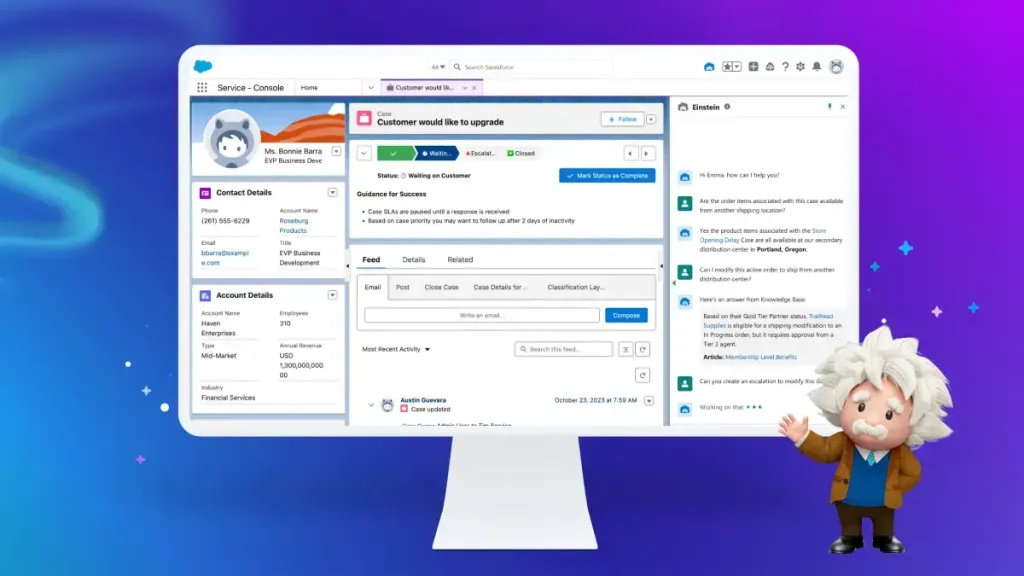
The speed of innovation in the world of AI — and specifically, generative AI — is continuing at a breakneck pace. With the technical sophistication that’s available now, the industry is rapidly evolving from assistive conversational automation to role-based automation that augments the workforce. In order for AI to mimic human-level performance, it’s vital to understand what makes humans most effective at completing jobs: agency. Humans can take in data, reason across possible paths forward, and take action. Equipping AI with this kind of agency requires an extremely high level of intelligence and decision-making.
At Salesforce, we’ve tapped into the latest advancements in large language models (LLMs) and reasoning techniques to launch Agentforce. Agentforce is a suite of out-of-the-box AI agents — autonomous, proactive applications designed to execute specialized tasks — and a set of tools to build and customize them. These autonomous AI agents can think, reason, plan, and orchestrate at a high level of sophistication. Agentforce represents a quantum leap in AI automation for service (customer, field, and employee), sales, marketing, commerce, and more.
This article sheds light on the innovations that culminated in the Atlas Reasoning Engine — the brain of Agentforce, incubated at Salesforce AI Research — and which orchestrates actions intelligently and autonomously to bring an enterprise-grade agentic solution to companies.
The evolution from Agentforce Assistant to Agentforce
Earlier this year we released Agentforce Assistant, which has now evolved into an Agentforce Agent for CRM. Agentforce Assistant was a generative AI-powered conversational assistant that derived its intelligence from a mechanism called chain-of-thought (CoT) reasoning ). In this mechanism, the AI system mimics human-style decision-making by generating a plan containing a sequence of steps to attain a goal.
With CoT-based reasoning, Agentforce Assistant could co-create and co-work within the flow of work, making it quite advanced compared to traditional bots, but it fell short of truly mimicking a human-like intelligence. It generated a plan that contained a sequence of actions in response to tasks and then executed those actions one by one. If the plan was incorrect, however, it did not have a way to ask the user to redirect it. This led to an AI experience that was not adaptive: Users could not provide new and useful information as a conversation progressed.
As we put Agentforce Assistant through rigorous testing with thousands of sellers from our own sales organization (Org 62), some patterns emerged:
- The natural-language, conversational experience of Copilot was much better than traditional bots, as expected, but it was not yet achieving the holy grail of being truly human-like. It needed to be more conversational.
- Copilot did an excellent job fulfilling user goals with the actions it was configured with, but it couldn’t handle follow-up inquiries about information that already existed in conversation. It needed to use context better to respond to more user queries.
- As we added more actions to automate more use cases, Copilot’s performance started to degrade, both in terms of latency (how long it took to respond) and response quality. It needed to scale effectively to thousands of use cases and applications that could benefit from it.
We set out to find a solution to these problems, and Agentforce was born.
Keep reading to discover why Agentforce represents a big leap in reasoning.
Find out more about the deep integrations across Google Cloud and Salesforce that can ease your enterprise’s agentic journey.